Wednesday, September 27, 2006

Samurai trilogy and Number 71


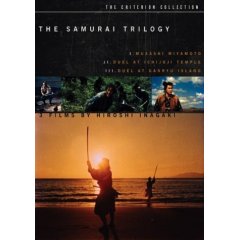
Over the past few weeks, I've watched the Samurai trilogy starring Toshiro Mifune with my wife. I had seen the first movie in film class and really enjoyed the great use of color and cinematography to tell this epic story. In many ways, this series is the ultimate Toshiro Mifune movie in that it demonstrates the type of character he excelled at: the wild man with grandiose aspirations transforming into the ultimate Japanese warrior. A large group of recurring characters keeps the story going and viewer interest up as Mifune's character goes on his journey.

The first movie centers on Mifune talking his friend into leaving town with him to try to become samurai. The friend leaves his fiancee' behind, Otsu, to take the trip. They end up taking refuge with a scheming widow and her daughter until brigands attack. Mifune's friend leaves with the scheming pair while Mifune is arrested for the assumed murder of his friend.

The local monk begins his training of Mifune from unfocused ruffian to trained samurai. In the meantime, Mifune and Otsu fall in love as Otsu devotes her life to following him (and its a long trip, trust me).

By the end of the first movie, Mifune leaves Otsu to hit the road and learn the ways of the force, er, samurai. The second movie centers on Mifune challenging other swordsmen and his continued development from undisciplined killer to controlled killer. There is a fantastic fight at the end where he takes on like 80 swordsmen and kicks ass through skill, power and strategy.

Otsu continues to follow him and other women throw themselves at him left and right. But he won't have anything to do with women because he's thinking of Otsu and then he blows it with her by practically attacking her. Otsu cries about it and Mifune renounces women! And what's funny is they write it in big letters on the screen as if this is a proud decision. Japan is known for being a little sexist but that's pretty extreme. Fortunately for Mifune, Otsu spends the next movie still following him around.

The third movie is Mifune learning the best fights are the ones he doesn't need to do and feeling bad about assaulting Otsu. A young upstart wants to make his name by killing Mifune. There is a climactic fight on the beach which is filled with tension and feeling. It's great stuff, though it's interesting to see another culture's concept of machismo. The trilogy ends with Mifune having killed like 100 people but he's still a virgin. On top of that, he seems like a sad virgin. But he is a samurai! A focused honorable killing machine that's not gettin' any.

My only negative comment is that the TV version of these movies were made from really scratchy and washed out prints. Everything seemed faded and soft focus, not at all like the way I remembered it 20 years ago. I hope the DVD's aren't as bad. The sexism is dated and humorous, my favorite part is where Mifune tries to break up with Otsu by saying "I prefer my sword to you." If that's not a loaded statement, I don't know what is. Yeah, sharpen that sword Mifune!

I actually really liked these movies and enjoyed the evolution of Mifune's character. The photography is fantastic, the characters are well drawn and realistic and the story immerses you in its ideas of code and honor. I highly recommend viewing these films.

Another story of growing up is at Number 71:

Counting Crows - August And Everything After (1993)

When I think of all the whiny classic rockers in alt rock wrapping, the first band I think of is Counting Crows. They look 90's and talk 90's but play like Jackson Browne's backing band with restrained guitars and blasts of organ. Singer Adam Durwitz mumbles and mopes with the weight of the world on his shoulders, walking a fine line between genuine expression and affectation. It sounds bad (and my wife would say is bad, she HATES this group), but it all works for me.

The main hit, the Van Morrisonish "Mr. Jones" is one of the big highlights on the album. It's also the only happy song on the album, practically a "Brown Eyed Girl" for the nineties. There are a handful of other uptempo numbers, mainly "Rain Kings" and "A Murder Of One" which find the group striking the balance between heavy concern and jubilation.

Mostly, the album is filled with ballads. The best ballad, the hit "Round Here", brings the Counting Crows sound into focus. A slow beat, churchy organ and sparkling guitars frame Durwitz's weary vocal and evocation of new found worldliness. Remember when you were 19 and going to a different town seemed like discovering a new universe? How grown up it made you feel? Counting Crows nails that feeling. "Anna Begins", "Time And Time Again" and the other songs are infused with the same sense of revelation.

Despite the borrowed early 70's influences (Van Morrison, The Band, Bob Dylan) Counting Crows manage to come up with an inspired debut that is both modern and classic. And no, I don't think "Mr Jones" is a code name for a sexual organ. It does make the song funnier, though. Sha la la la indeed!


Thursday, September 21, 2006

Red Hot Chili Peppers and Number 72


Ah, double albums...without double albums, there would be no "Frampton Comes Alive", no "Sign O The Times" and no "Use Your Illusions." There are certain inbred motivations to making a double album: ego, musical experimentation, career capping BIG STATEMENT, ego, or talented people on a creative hot streak. Did I mention ego? The recent Red Hot Chili Peppers double disc set Stadium Arcadium exhibits all of the symptoms listed. It's a career capping BIG STATEMENT where the Peppers mix a few new sounds into their established repitoire of funk rock and soft ballads. It doesn't quite have the "get the funk out" of their early releases nor the somnambulent soft rock of their recent releases. The bands previous release, 2002's By The Way was a snoozer once you got past the punk/funk title track.

Still, if a current band could potentially pull off a double album it would be the Chili Peppers. Stadium Arcadium does the band justice, they play in the pocket with a natural feel that comes from years of playing together. They get buckwild on their funky tunes like the recent hit "Tell Me Baby" or "Warlocks". Grinding funk is delivered on "Storm In A Teacup" and my personal favorite on the disc, "Readymade". Strummy acoustic rock comes in on "Make You Feel Better". Californicatin' balladry comes up on the title track "Stadium Arcadium".

The Peppers experiment a little, such as on the Pink Floydish "Strip My Mind" or the horn warbling "Torture Me". But experimentation is actually kept to a minimum considering this is a double album. But the Chili Pepper's ability to come up with lively riffs and jumpy beats keeps everything flowing nicely.

Where Stadium Arcadium runs into problems is the actual songs. They all sound pleasant when they're on, but there's nothing memorable on either disc. The first single from the album was "Dani California", a fairly blatant Tom Petty rip off with Hendrixian guitar tacked on the end (Great video though). The second song on the disc is the abysmal "Snow ((Hey Oh))". That song Sucked-Oh. As much as I've played this CD since I've gotten it, I'm looking at the song titles right now and only remember half of the songs. 2002's By The Way suffered from the same lack of hooks.

The weak songwriting keeps Stadium Arcadium from being the end all / be all Chili Peppers disc it's meant to be. And that's too bad, because the Peppers can still come up with tasty licks and goofy attitude at a drop of the hat. It doesn't ruin the album, Stadium Arcadium still packs a pretty good punch and any other cliche' I can think of. So I'm giving this a 7 out of 10.

One band that wouldn't know funk if it fell on it is at Number 72:

Yes - 90125 (1983)

I remember the first time I saw this album. My neighbor, who was really into rock music and would let me copy his records (pretend I didn't say that RIAA), brought this record over to my house and said "If you like Asia, you'll love this band. They have two singers." I was skeptical, but I played it. AND IT WAS THE GREATEST THING I EVER HEARD. I couldn't believe a band could take a pop/rock sound and expand it into something bizzarly riddled and intellectually challenging.

The songs had extremely catchy melodies in both the instrumental breaks and the vocals. "It Can Happen" with it's sitar sounding guitar and Supertrampish chorus ("It Can Happen To You / It Can Happen To Me / It Will Happen To Everyone Eventually") amazed me. The repetitious plunking keyboard riff to "Changes" and the hard charging instrumental "Cinema" impressed me with their dazzling interband chemestry and the fretboard fireworks of guitarist Trevor Rabin. The lumbering bass attack and steady drumwork of Chris Squire and Alan White on "Hold On" and "City Of Love" provided muscle to an otherwise light album. High pitched vocalist Jon Anderson shines on the near a capella "Leave It" while his dense, puzzling lyrics left me pondering the meaning of his words for hours (years later, I'm convinced he takes random words and pulls them from a hat because I can't discern any meaning past the Trevor Rabin penned choruses).

But the true highlight is, of course, "Owner Of A Lonely Heart". This song came out of nowhere with its sound fx heavy production, bouncy beat and horn sampled synth breaks. "Owner" became Yes's first and only Number 1 hit. Though the song was largely written by Trevor Rabin (on the toilet, no less) the credit for the success of the tune belongs to producer Trevor Horn. Horn, a former Yes man himself, produces "Owner Of A Lonely Heart" with gusto. The drums sound like collapsing cardboard boxes at the beginning, the catchy bass line is at the forefront of the song and offsets Jon Anderson's high toned voice. Acoustic guitars overdub on top of electric guitars, the instrumental breaks stab in and out and the guitar solo sounds like a buzzsaw. It's fantastic stuff.

This album made me a lifelong Yes fan and I sought out the previous albums of the band. I saw Yes live twice on the 90125 tour (I kept thinking the number was made up of the years of seniority for each member of the group, it's really the Atco catalog number) and was blown away by Trevor Rabin's playing (He plays restrained on record but overshreds live. He sounds great!). After 90125, I considered Yes one of my favorite bands. One of my first college roommates was chosen due to a mutual fanship of Yes.

I was sure they would record another album right away, so I patiently waited for the next set of songs. And I waited, and I waited, and soon it was 1987. Yes finally released Big Generator. I had come full circle, I was starting high school during 90125 and I was in the middle of college for Big Generator. When I heard Big Generator, I was disappointed to learn the magic was gone. There were a handful of good songs, but Generator sounded like a bad ready to quit. Jon Anderson left Yes after the tour to form a band with the old Yes members, Steve Howe, Rick Wakeman and Bill Bruford.

Yes remains one of my favorite bands and I have since learned to enjoy all of the phases of this groups career. But I will always consider 90125 to be a special album.

Tuesday, September 19, 2006

Thank you and Elephant


First, I would like to take the time to thank anyone who may have been reading my ramblings over the past few months. It's been a lot of fun and I plan to continue making blog entries until I run out of media to experience. As my role model William Shatner might say, That...may...take...a.............while. So thanks for reading!

Last weekend, I had the opportunity to watch Gus Van Zant's Elephant (2003). Elephant is a not to subtle fictional take on the Columbine tragedy. The movie was a little bizarre in that it was highly effective on an artistic level but it's view of teenage life was a little too cold for me. Between this and Last Days (2005), a movie I plan to watch soon that is supposed to be a fictional take on Kurt Cobain's suicide, I'm starting to think of Gus Van Zant as Mr. Instant Replay. It's like something monumental happens, Gus is there to give his fictional view of it. He walks a fine line between art and exploitation, but in Elephant he has enough talent to pull it off. Just barely though.

Elephant takes place at an affluent upper middle class highschool that looks suspiciously like...Columbine. It follows a handful of characters through their day, taking the time to focus on the mundane parts of their lives to really make the viewer live with them. It's a bold move, I've never seen a movie feature the backs of actors heads as prominently as Elephant. In this movie, if a character walks from one room to another, the camera follows the WHOLE walk in a medium closeup head shot from the back. It gets a little annoying, but anyone who has walked through a highschool hall will easily relate.

Other camera shots and sequences are very well photographed, they have a look of digital video clarity and have the framing of home video but the shot composition is almost poetic. Subjects flow in and out of frame and Van Zant clearly made careful choices in having the action of certain scenes off camera while visually focusing on a different subject entirely. A good example is a shot that introduces a character by showing a field where a class is in PE. It's a static wide shot where kids play football in the foreground while cheerleaders and runners move in the background. After about 3 minutes of this the character being introduced stops playing football and runs from the back of the shot to the front. This technique is effective in grounding the viewer in "reality" and giving context to the character (you assume he is a jock).

Elephant is sensitive and subtle in its depiction of the teenage killers. Many of the Columbine traits are there; the facination with heavy weaponry, Nazis and the general abuse they receive from other students. The movie tries hard to not pass judgement on these characters themselves than on the circumstances that surround them. The parents are portrayed as wealthy but uncaring (and almost invisible from the way they were shot outside of frame) . The two teens lack of parental influence, access to dangerous materials, television fed intellect and outsider status are illustrated to "support" the pathological frame of mind of these ticking time bombs.

What loses me about Elephant is the dim view it takes towards people. Almost all of the characters are put upon in some way, whether by an individual, the school or society. The adults are portrayed as hopelessly out of touch (or drunk), inflicting their pathos, power trips or indifference onto the teens. A cross section of teens are shown, a popular kid, a geek, a loner, a boyfriend with girlfriend, a trio of teen queen girls and the two outsiders. The tone of the movie and the portrayal of these characters seem to suggest that all teenagers struggle with loneliness to the point of self destruction with the two teen killers gleefully murdering other students as its biggest symptom. I can't quite buy into the cynical point of view taken here and takes a little out of the movie for me.

However, the ending where the massacre takes place is gripping and chilling. The matter-of-fact tone sets up the devastating view of the two teenage killers shooting other students as if they were in a video game. The scenes of other students fleeing from the school is a mirror image to newscasts from Columbine. Watching the two student killers finally show happiness when they're murdering people is fairly gut wrenching.

Elephant wins points for its re-enactment skills but ultimately the movie wants you take it both ways. It's an almost faithful illustration of a factual event played out as fiction to allow spin and probably dodge lawsuits. From an artistic point of view, the movie is amazing in its ability to tell a story of multiple characters and have the viewer feel like a "fly on the wall" of their lives. I can't recall seeing any recent movie with as much skilled technique as this one in both shooting and editing. But the fictional spin on a well documented actual event makes me wonder if I'm being sold imagination as fact. The line is blurred here, an artistic triumph that confuses real life issues. So I will split the difference and give Elephant an 5 out of 10.