Tuesday, September 19, 2006

Thank you and Elephant


First, I would like to take the time to thank anyone who may have been reading my ramblings over the past few months. It's been a lot of fun and I plan to continue making blog entries until I run out of media to experience. As my role model William Shatner might say, That...may...take...a.............while. So thanks for reading!

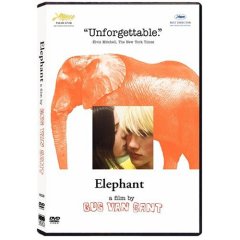
Last weekend, I had the opportunity to watch Gus Van Zant's Elephant (2003). Elephant is a not to subtle fictional take on the Columbine tragedy. The movie was a little bizarre in that it was highly effective on an artistic level but it's view of teenage life was a little too cold for me. Between this and Last Days (2005), a movie I plan to watch soon that is supposed to be a fictional take on Kurt Cobain's suicide, I'm starting to think of Gus Van Zant as Mr. Instant Replay. It's like something monumental happens, Gus is there to give his fictional view of it. He walks a fine line between art and exploitation, but in Elephant he has enough talent to pull it off. Just barely though.

Elephant takes place at an affluent upper middle class highschool that looks suspiciously like...Columbine. It follows a handful of characters through their day, taking the time to focus on the mundane parts of their lives to really make the viewer live with them. It's a bold move, I've never seen a movie feature the backs of actors heads as prominently as Elephant. In this movie, if a character walks from one room to another, the camera follows the WHOLE walk in a medium closeup head shot from the back. It gets a little annoying, but anyone who has walked through a highschool hall will easily relate.

Other camera shots and sequences are very well photographed, they have a look of digital video clarity and have the framing of home video but the shot composition is almost poetic. Subjects flow in and out of frame and Van Zant clearly made careful choices in having the action of certain scenes off camera while visually focusing on a different subject entirely. A good example is a shot that introduces a character by showing a field where a class is in PE. It's a static wide shot where kids play football in the foreground while cheerleaders and runners move in the background. After about 3 minutes of this the character being introduced stops playing football and runs from the back of the shot to the front. This technique is effective in grounding the viewer in "reality" and giving context to the character (you assume he is a jock).

Elephant is sensitive and subtle in its depiction of the teenage killers. Many of the Columbine traits are there; the facination with heavy weaponry, Nazis and the general abuse they receive from other students. The movie tries hard to not pass judgement on these characters themselves than on the circumstances that surround them. The parents are portrayed as wealthy but uncaring (and almost invisible from the way they were shot outside of frame) . The two teens lack of parental influence, access to dangerous materials, television fed intellect and outsider status are illustrated to "support" the pathological frame of mind of these ticking time bombs.

What loses me about Elephant is the dim view it takes towards people. Almost all of the characters are put upon in some way, whether by an individual, the school or society. The adults are portrayed as hopelessly out of touch (or drunk), inflicting their pathos, power trips or indifference onto the teens. A cross section of teens are shown, a popular kid, a geek, a loner, a boyfriend with girlfriend, a trio of teen queen girls and the two outsiders. The tone of the movie and the portrayal of these characters seem to suggest that all teenagers struggle with loneliness to the point of self destruction with the two teen killers gleefully murdering other students as its biggest symptom. I can't quite buy into the cynical point of view taken here and takes a little out of the movie for me.

However, the ending where the massacre takes place is gripping and chilling. The matter-of-fact tone sets up the devastating view of the two teenage killers shooting other students as if they were in a video game. The scenes of other students fleeing from the school is a mirror image to newscasts from Columbine. Watching the two student killers finally show happiness when they're murdering people is fairly gut wrenching.

Elephant wins points for its re-enactment skills but ultimately the movie wants you take it both ways. It's an almost faithful illustration of a factual event played out as fiction to allow spin and probably dodge lawsuits. From an artistic point of view, the movie is amazing in its ability to tell a story of multiple characters and have the viewer feel like a "fly on the wall" of their lives. I can't recall seeing any recent movie with as much skilled technique as this one in both shooting and editing. But the fictional spin on a well documented actual event makes me wonder if I'm being sold imagination as fact. The line is blurred here, an artistic triumph that confuses real life issues. So I will split the difference and give Elephant an 5 out of 10.

Thursday, September 14, 2006

Bruce Springsteen and Number 73


I've listened to Bruce Springsteens' recent disc We Shall Overcome: The Pete Seeger sessions and I keep coming back to the same conclusions. Love the performer, love the performance, can't take the genre. Interestingly, the disc ushers in a sort of creative rebirth for the Boss. As far back as the early 90's, Springsteen has expressed a wish to change his sound and come up with something new. Unable to make a complete change, Springsteen settled into writing a series of songs about Mexican Cowboys and CNN headlines. On We Shall Overcome, all of that changes.

It's the type of album that usually heralds a commercial and creative triumph. Usually, the media loves it when a classic rocker jumps into a different style of music for inspiration (Paul Simon's Graceland or even Rod Stewarts recent American Songbook discs are fine examples). On We Shall Overcome, Springsteen picks out a set of folk songs from the 19th and early 20th century. Sadly, it seems Springsteen's lefty politics have taken him out of the media just when it seems CMT would welcome him as a rocker going country. Springsteen uses a set of talented musicians to back him on Overcome, giving authenticity to ancient songs like "Old Dan Tucker", "John Henry" and "Shenendoah". Fiddles and horns swing about like crazy and just about every other analog musical instrument makes an appearance as well.

Springsteen delivers his most happy, impassioned vocal performance since 1985 throughout the disc. He sounds fired up as he growls through his verses and shouts in the choruses just as he did in his classic period (1975 to 1985). For the past twenty years, Springsteen's vocals were limited to a hushed whisper or a heavy toned stateliness that always sounded serious to the point of repetition.

Despite these positive attributes plus some songs I genuinely like ("O Mary Don't You Weep" has a happy gospel tone, "Pay Me My Money Down" sounds like a seaside chant) I ultimately cannot bring myself to fully like this album. Old folk and dixieland jazz sounding tunes just aren't my thing, no matter how well it's performed. I respect Springsteen's artistry and am happy he found inspiration in something for a change. But ultimately, I can't follow him on this one. 6 out of 10.

Of course, instead of following his muse and showing creativity Springsteen could have sold out like Number 73:

Heart - Heart (1985)

When Heart released their eponymous album in 1985, I had already been a fan for a few years. Even before I bought records, I always had a good time listening to "Crazy On You", "Barracuda" and "Straight On" whenever they came on the radio. One of the first records I bought was Heart's Passionworks album (1983), which had one great song ("How Can I Refuse") and a remainder of crap. Passionworks was and is one of the dullest records I've ever sat through. So, it was no accident when Heart found themselves under the hand of a commercial producer (Ron Nevison) and outside songwriters the next time out.

In '85, I loved the arena rock bands like Journey, Heart, Survivor and so on. When Heart released their first video, "What About Love", I was hooked. I really liked the overdone Victorian rock duds and "Love" was a powerballad of the highest order. Ann Wilson was given room to wail like Steve Perry on estrogen while the video featured a writhing Nancy Wilson on guitar.

Other hits followed. "Never" with its midtempo beat and shiny guitars also caught on thanks to a video that had Nancy Wilson jump around like a phone sex advertisement. She bounces, shimmies and shakes throught the clip. She had more screen time than Ann Wilson, who actually sings the song! Nancy Wilson took lead vocals on "These Dreams", a ballad Stevie Nicks turned down and Heart's first Number 1 hit. "Nothin' At All" benefited from a twin guitar solo and breezy chorus.

Away from the hits, Heart successfully try to rock things up with the opening song "If Looks Could Kill" and the closer "Shell Shock". Even better was a B-side only song I had on the "What About Love" 45 record, a dark rocker called "Heart Of Darkness". Their hard rock edge really showed live, when I saw them in 1985 their Zeppelineque cut "The Wolf" came alive in a way that didn't come across on vinyl. Elsewhere, the band plays the ballad "Nobody Home" with a great guitar solo featuring Frankie Sullivan of Survivor.

Racking up multiple top 10 hits brought Heart back from being a forgotten band to one of the most respected rock bands in the business. Heart sold their soul to get hit singles, but the ploy worked. Their polished, manufactured sound is stiff and poppy, but Ann Wilson's powerful voice cuts through all the gloss. Heart may look at this period as an embarassment, but it's my favorite Heart album of all time.

Wednesday, September 13, 2006

Rockstar Supernova and Number 74


Tonight concluded the summer CBS tv series Rockstar: Supernova bringing an end to the speculation of who would be the lead singer for the supergroup. Singer Lukas Rossi, a singer who looks and sound like a cross between STP's Scott Weiland and Oasis' Liam Gallagher took the prize defeating the over emotional yet talented Dilana. Rossi will record an album as frontman for a band that includes drummer Tommy Lee (Motley Crue), bassist Jason Newsted (Metallica) and guitarist Gilby Clarke (Guns N Roses). Veteran mainstream rock producer Butch Walker will be on board for the album.

On paper, this looks like a terrific television show and a can't miss rock band but faults in both show on closer inspection. The television show is mediocre, it has a wooden pinup host (model Brooke Burke), a license to maybe twelve songs (Evanescence's "Bring Me Back To Life" was used three times by three different singers) and a spotty bunch of would-be rock stars for contestants. The band has name players, but none of the members were the "key" performers of their respective former bands. Tommy Lee has the biggest name of the supergroup, but his reputation has absolutely nothing to do with any musical talent (though he is said to have a BIG drumstick, if you know what I mean and I think you do).

So, why did I watch the show? Well, one reason is I love rock music and this show is one of the few media outlets left to hear new music and musicians. Also, I was a big fan of Dilana (the goth rocker had a gravelly blues mama voice and an alternative rock edge) who repeatedly gave impressive performances through much of the show. Unfortunately, Dilana's ego got carried away and she trashed her opponents in the press. The resulting audience backlash took the wind out of her sails, Dilana's performances floundered and could not regain her footing until the final episode.
While Dilana dissolved into an emotional wreck, Aussie Toby Rand stepped up his game to become a crowd pleasing arena rocker while Lukas Rossi's assured, cocky stage presence and displayed growth in his singing style at the urgings of Jason Newsted.

Another reason was the show had a bit of whackiness this year. Early contestant Zayra turned every song into a screechy, stiff rhythm techno bit. Zayra butchered songs week after week in a way that took originality in presentation and zero musical talent. You haven't heard "867-5309 Jenny" until you've heard it done as if she was a spanish Grace Jones. She was fun. Jill Gioia couldn't decide if she was a teasing sexpot, Courtney Love or bar band floozie resulting in her dismisal. Ryan Starr showed development from stage panicked singer to being the American Coldplay. but his bizarre hoody mohawk gimmick backfired on him hilariously.

At this time, the 90's band Supernova has successfully sued to protect their name so the Rock Star band now has no name at all. The handful of new songs written by the new group all sucked big time. But hearing new music and musicians rise to the occasion, such as on Toby Rand's self penned pop punk song "Throw It Away" or Dilana's spinetingling renditions of haunted ballads like "Roxanne" or "Time After Time" makes it all worth while.

In the meantime, the band may need a new name like Motleygunsica or Metalliroses Crue to remind audiences of who they are. No matter what they call themselves, they will never come up with a name as good as Number 74:

Van Halen - Van Halen I (1977)

The album that revolutionized hard rock and turned a nation of teenage guitarists into finger tapping monsters, Van Halen I was the hard rock album to beat for many years. The band attacked listeners with an onslaught of audio and visual data in their performances. Guitarist Eddie Van Halen's "hammer on" technique created a souped up guitar sound with faster than light solos and speed demon fills. Visually, lead singer David Lee Roth redefined the role as an acrobatic circus clown. Roth's martial arts training gave him the ability to launch huge jumps off the stage or drum riser to give a visceral flair to the songs. His overconfidence bordered on insanity as he pushed every element in his life (womanizing, extreme sports, partying) beyond its limit.

Best of all, Van Halen grabs the listener by the collar and doesn't let go on every song. The band matches the fleetfingered guitarwork and Roth's amateurish vocals to fast paced songs like "Ain't Talkin' 'Bout Love" and "Atomic Punk" that barrel down the road at top speed. More midtempo, popier songs effectively catch the listener's ear ("Jamie's Cryin" and "Feel Your Love Tonight"). A hyperactive remake of the Kink's "You Really Got Me" blows the doors of the original thanks to Eddie Van Halen's scorching guitar solo.

But the best song is the lead track, "Running With The Devil". "Devil" is set to a steady, anthemic guitar/ bass riff spiked with dazzling guitar runs during the fills and solo. Meanwhile, Roth struts his casually crass attitude in creating a memorable rock anthem.

All of the songs on this album are winners and that's why it's the Number 74 selection.